Book an appointment
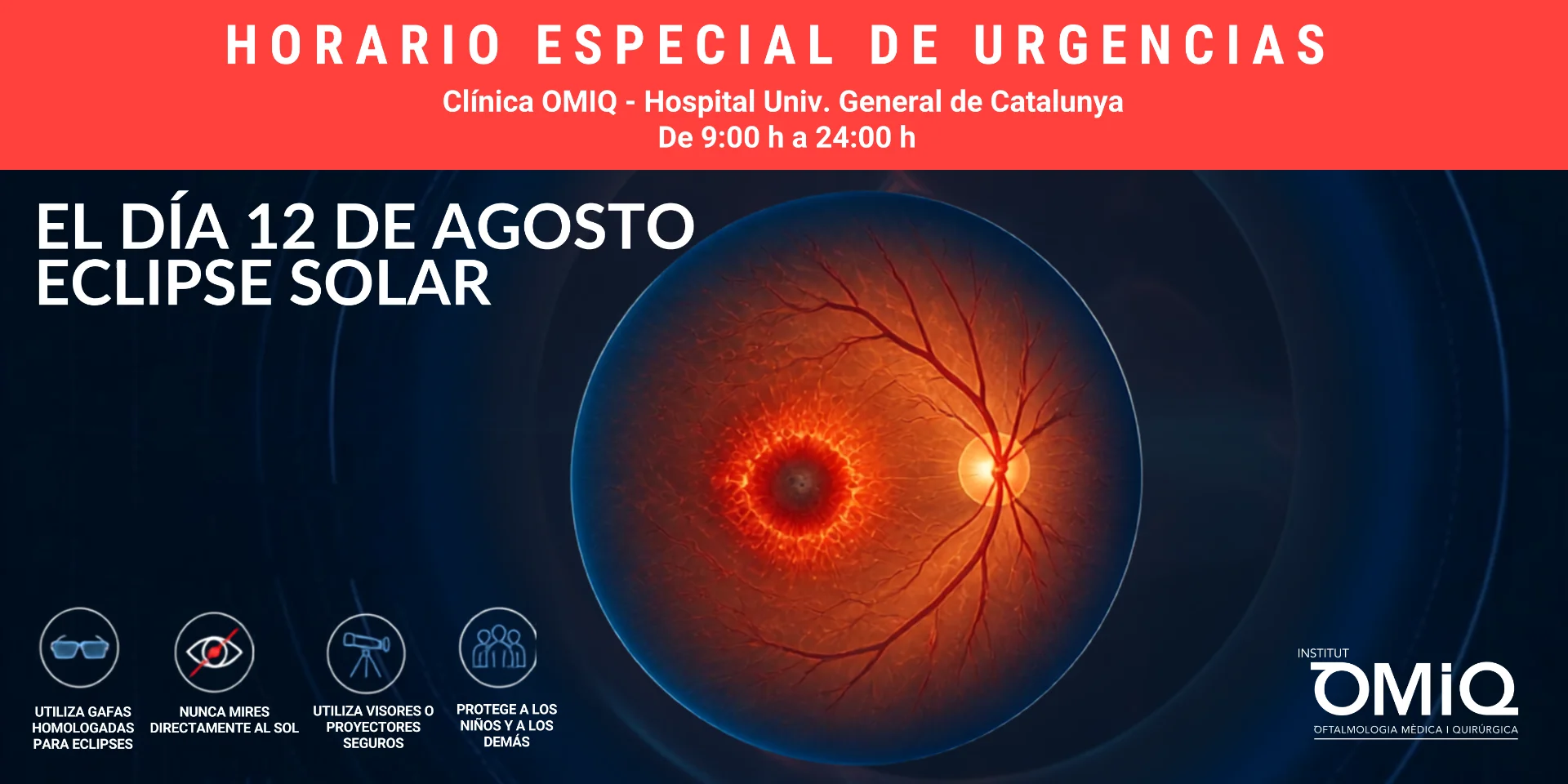
On August 12, we will experience one of the most anticipated astronomical events of recent years: a solar eclipse. It will be a unique moment for thousands of people who will want to look to the sky and enjoy a spectacle that nature offers us only on rare occasions.
Sin embargo, desde Institut Oftalmològic OMIQ Mèdic i Quirúrgic queremos recordar que observar un eclipse de forma incorrecta puede provocar lesiones graves e incluso irreversibles en la retina. Aunque el Sol esté parcialmente oculto por la Luna, su radiación continúa siendo extremadamente intensa y peligrosa para nuestros ojos.
However, at the OMIQ Medical and Surgical Ophthalmological Institute, we want to remind you that observing an eclipse incorrectly can cause serious and even irreversible damage to the retina. Even though the Sun is partially obscured by the Moon, its radiation remains extremely intense and dangerous for our eyes.
Therefore, enjoying the eclipse and protecting your visual health should always go hand in hand.
Why is it dangerous to look at a solar eclipse?
Many people believe that during an eclipse the Sun ceases to be dangerous because its brightness decreases. However, this is a very common misconception.
Even though part of the solar disk is hidden by the Moon, ultraviolet (UV) radiation, infrared radiation, and intense visible light still reach our eyes with enough energy to cause retinal damage.
Furthermore, as ambient light decreases, the pupil tends to dilate slightly, allowing more radiation to enter. This combination makes direct observation of the eclipse especially dangerous if proper filters are not used.
What is solar retinopathy?
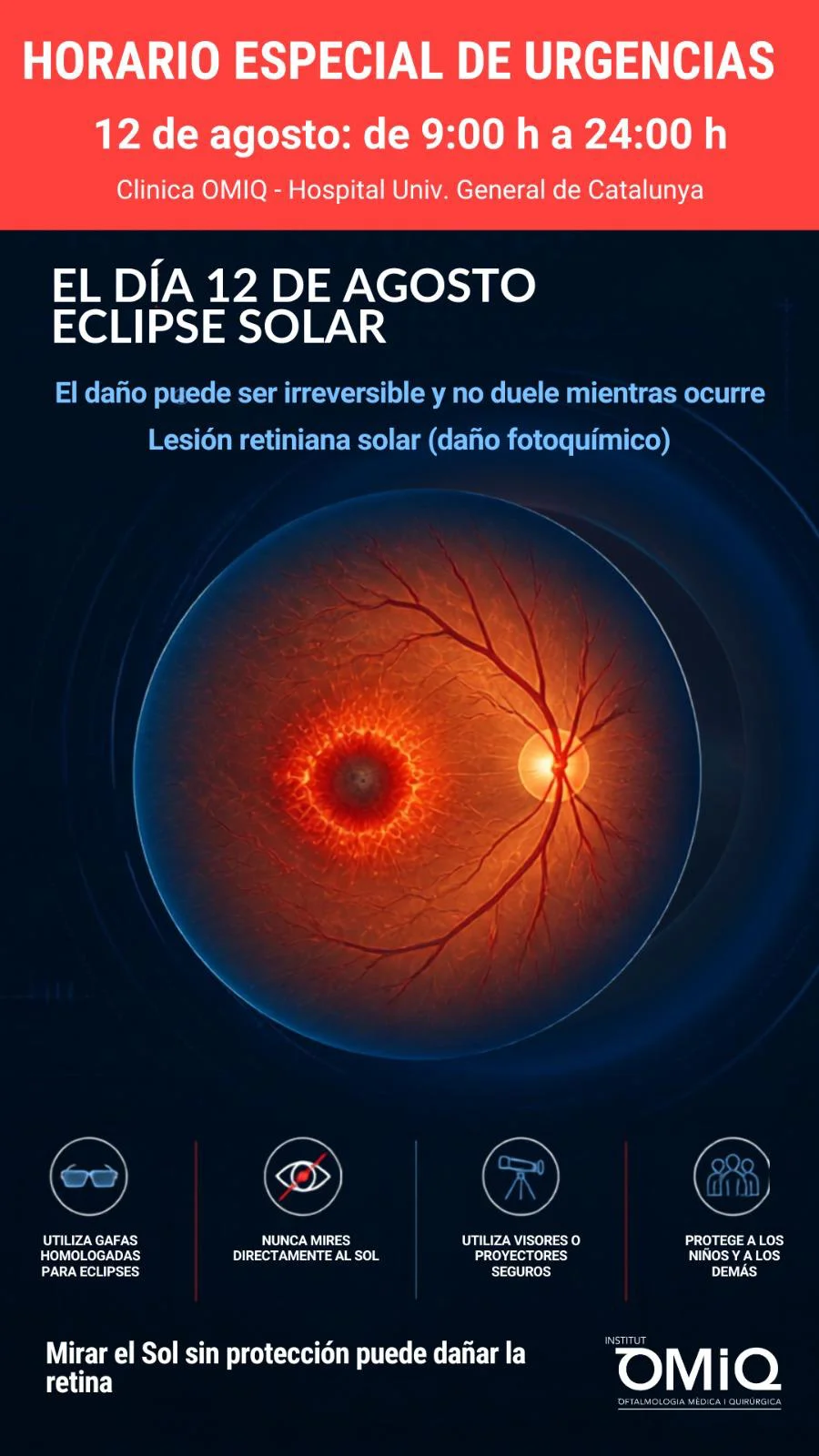
The most common eye injury related to direct observation of the Sun is called solar retinopathy.
It occurs when intense solar radiation causes photochemical damage to the macula, the central part of the retina responsible for high-precision vision. Thanks to the macula, we can read, recognize faces, drive, use electronic devices, and distinguish fine details.
Cuando esta zona resulta lesionada, la calidad visual puede verse seriamente comprometida.
When this area is damaged, visual acuity can be seriously compromised.
What symptoms can it produce?
Symptoms usually appear between a few hours and one or two days after sun exposure. The most common are:
- Blurred vision.
- Appearance of a dark spot in the center of vision.
- Difficulty reading.
- Problems recognizing faces.
- Distortion of straight lines.
- Decreased visual sharpness.
- Altered color perception.
- Sensation that objects appear distorted.
If you experience any of these symptoms, it is important to have an eye exam as soon as possible.
Is there a treatment?
In some patients, vision improves gradually over the months thanks to partial retinal recovery. However, when the damage has been significant, the aftereffects can be permanent.
In some patients, vision improves gradually over the months thanks to partial retinal recovery. However, when the damage has been significant, the aftereffects can be permanent.
That’s precisely why prevention is the best way to protect our vision.
How to observe the eclipse safely?
The only safe way to look directly at the Sun during an eclipse is to use eclipse glasses certified to ISO 12312-2.
These glasses incorporate special filters capable of blocking harmful solar radiation and allowing for safe viewing.
Before using them, it’s advisable to check that:
- They have ISO 12312-2 certification.
- They include the CE marking.
- They clearly indicate the manufacturer.
- They include instructions for use
- The filters are completely clean and free of scratches, tears, or damage.
If the glasses show any signs of damage, they should not be used.
What you should never use
Despite the numerous tips circulating online, there are methods that should never be used to observe an eclipse.
The following are unsafe:
- Smoked glass.
- Conventional sunglasses.
- X-rays.
- CDs or DVDs.
- Old photographic film.
- Homemade filters.
- Los cristales tintados.
Although they reduce the intensity of visible light, none of these materials adequately block solar radiation that can damage the retina.
Exercise extreme caution with binoculars, telescopes, and cameras.
Los instrumentos ópticos concentran la luz solar y multiplican su intensidad.
Therefore, an eclipse should never be observed using binoculars, telescopes, cameras, or video cameras without solar filters specifically designed for these devices.
It is important to remember that certified eclipse glasses do not replace the special filters required by these devices.
SPECIAL ATTENTION TO CHILDREN
Children need constant supervision while observing the eclipse.
When looking through certified eclipse glasses, they perceive very little light and are often tempted to lift them or look over the top of them for a few seconds.
That brief moment can be enough to cause retinal damage. Paragraph
For this reason, children should always observe the eclipse accompanied by an adult.
What to do if you don’t have certified eclipse glasses?
If you don’t have certified eclipse glasses, the safest recommendation is not to look directly at the Sun.
Currently, numerous live broadcasts from astronomical observatories, scientific institutions, and media outlets allow viewers to enjoy the phenomenon without risking their vision.
When should we see an ophthalmologist?
After observing an eclipse, it is advisable to schedule an eye exam if the following symptoms appear:
- Blurred vision.
- Mancha en el centro de la visión.
- Difficulty reading or focusing.
- mage distortion.
- Decreased visual acuity.
- Color alteration.
An ophthalmological examination will allow for the assessment of the retina’s condition through specific tests and the detection of possible lesions.
Frequently asked questions about the solar eclipse:
Are sunglasses suitable for viewing an eclipse?
No. Sunglasses, however dark, do not block the solar radiation necessary to protect the retina. Only certified eclipse glasses with ISO 12312-2 certification should be used.
Is it dangerous to look at the Sun for just a few seconds?
Yes. Even very brief exposure can cause photochemical damage to the retina without the person feeling pain at that moment.
Can I take photos of the eclipse with my mobile phone?
If the phone is pointed directly at the sun, it is also advisable to use appropriate filters and avoid looking at the screen for extended periods if the proper equipment is not available. Specific solar filters are essential for professional cameras or telescopes.
What does ISO 12312-2 certification mean?
Es la norma internacional que garantiza que las gafas para eclipses cumplen los requisitos de seguridad necesarios para observar el Sol de forma directa.
Is solar retinopathy curable?
In some cases, vision improves partially over time, but there is no treatment that completely repairs the damage when the lesion is significant. Therefore, prevention remains the best protection..
Prevention is the best way to care for your vision.
The solar eclipse on August 12th will undoubtedly be an unforgettable event. At the OMIQ Medical and Surgical Ophthalmological Institute, we encourage you to enjoy this natural phenomenon safely.
Always remember these five essential recommendations:
- Use only approved eclipse glasses with ISO 12312-2 certification.
- Never look directly at the sun without proper protection, even if it is partially obscured.
- Do not use binoculars, telescopes, or cameras without certified solar filters.
- Supervise children at all times during observation.
- If you notice any visual disturbances after the eclipse, seek an eye exam as soon as possible.
An eclipse lasts only a few minutes… but retinal damage can last a lifetime.
At Institut Oftalmològic OMIQ Mèdic i Quirúrgic we work every day to prevent, diagnose and treat them.